
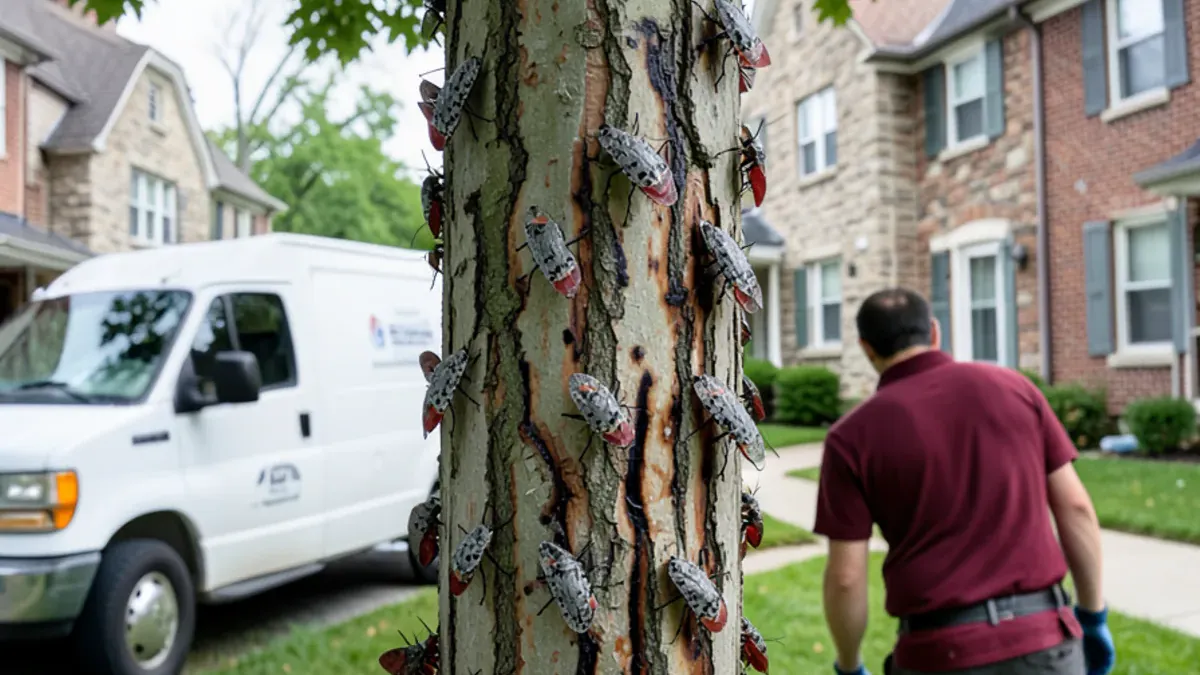
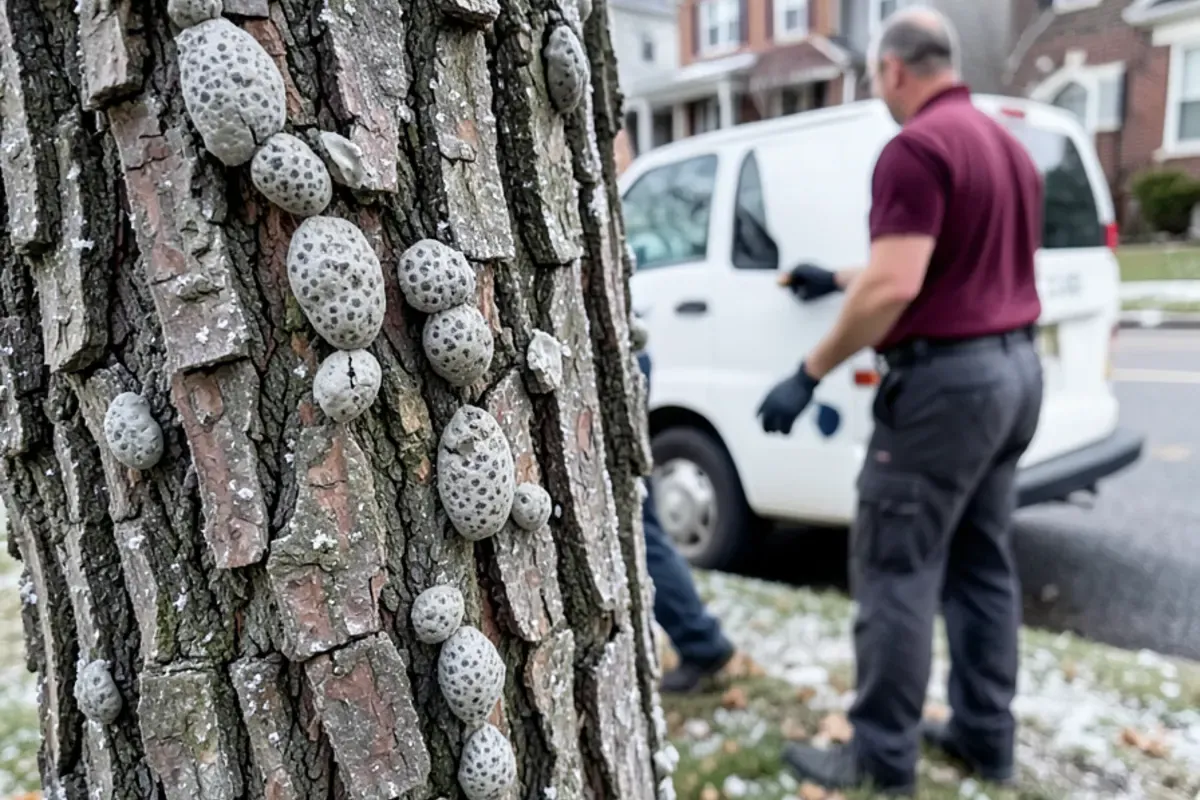
What Do Lanternfly Eggs, Nymphs and Adults Look Like?
Each life stage looks different, which is why many homeowners miss the early signs. Watch for:
- Egg masses (fall to spring): flat, gray, putty-like smears about an inch or two long on bark, stone, fences, outdoor furniture and vehicles. Older masses look cracked, like dried mud.
- Early nymphs (May to July): small, black, wingless insects with white spots that jump when disturbed.
- Late nymphs (July): larger and bright red with black and white markings.
- Adults (July until a hard freeze): about an inch long, with gray, black-spotted forewings that flash red hindwings in flight.
- Honeydew and sooty mold: a sticky film on decks, cars and plants beneath infested trees, often turning black with mold and drawing bees, wasps and ants.
- Weeping sap: dark, wet streaks on trunks where lanternflies are feeding in large numbers.
What the PDA Quarantine Means for Delaware County Homes
The Pennsylvania Department of Agriculture's spotted lanternfly quarantine covers the southeastern counties, including Delaware, Chester, Montgomery, Bucks and Philadelphia. Inside the zone, the state asks residents to check vehicles, firewood, outdoor furniture and other items for egg masses and hitchhiking insects before moving them.
The permit side applies to businesses rather than households: companies that move vehicles or goods within or out of the zone need a PDA spotted lanternfly permit, earned by completing PDA's training. Treatment itself is a pesticide application, so the Pesticide Control Act of 1973 applies, and any provider should be able to give you its PDA business license number.
Businesses that move goods or vehicles in and out of the quarantine should check PDA's permit requirements directly. This is general information, not legal advice.
Tree of Heaven and Other Local Host Plants
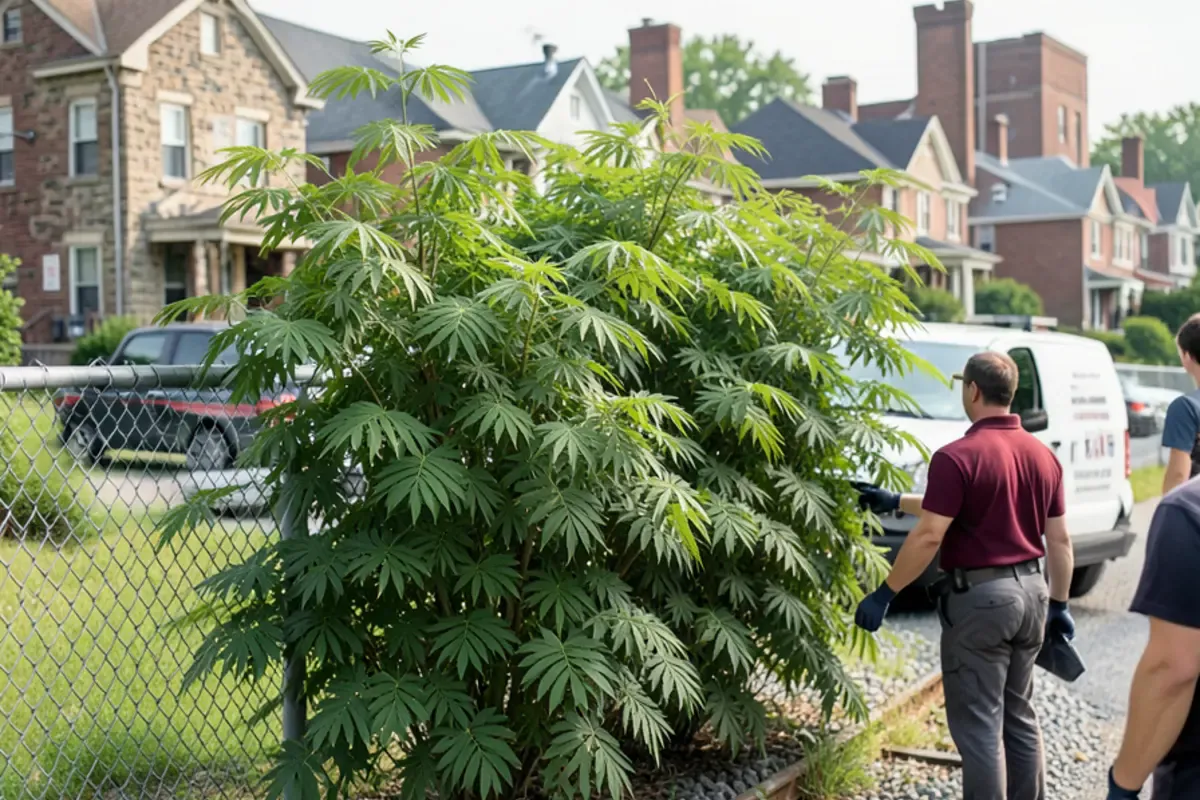
The lanternfly's favorite host is tree of heaven, an invasive tree that grows fast along rail lines, highway shoulders, vacant lots and the industrial riverfront between Chester and Marcus Hook. Where tree of heaven grows near homes, lanternfly numbers tend to be heavy.
They also feed on red and silver maples, black walnut, willows, birch and grapevines, all common in Delaware County yards. Healthy shade trees usually survive the feeding, but repeated heavy infestations stress them, and grapevines and young trees can suffer real damage.
Why Some Delaware County Yards See Lanternfly Swarms
Spotted lanternflies were first found in the U.S. in Berks County, Pennsylvania, in 2014, and they spread mostly by hitching rides. Egg masses laid on vehicles, rail cars, trailers and stacked materials travel far faster than the insects can fly. Delaware County sits on some of the region's busiest routes, including I-95, I-476 and the rail lines through Media, Wawa and the riverfront, so new adults arrive every summer even in yards that were cleared the year before.
Yard layout decides how bad it gets. Homes that back onto a rail embankment, a highway sound wall or an overgrown vacant lot usually have tree of heaven within flying distance, and adults move from there onto maples, walnuts and grapevines. Decks and patios under those trees collect honeydew first, which is often the earliest sign people notice in August, soon followed by adults lining up along the trunks of host trees.
How We Inspect Trees and Outdoor Surfaces
The free inspection covers trunks and limbs we can see from the ground, the undersides of branches, fences, stone walls, sheds, play sets, firewood and anything stored outside. We identify host trees, look for tree of heaven on or near the property and count egg masses or active insects to judge pressure.
We also note which trees are flowering or about to flower, because any insecticide work on those trees has to wait until bloom is over to protect pollinators. The written quote lays out what to treat, when, and what you can safely handle on your own.
Talk to us about spotted lanternfly control
Call and speak with Thom or his team. The inspection is free, and you get a written quote before any treatment.
- ★ 4.8 from 21 Google reviews
- Open 7 days, 8 a.m. to 7 p.m.
- Free inspection before treatment
- Family-run, based in Media, PA
Open 7 days, 8 a.m. to 7 p.m.
Spotted Lanternfly Treatment Options, With Trade-Offs
No single method clears a yard, because adults keep flying in from untreated trees nearby. A combination is usually the practical answer.
- Egg mass scraping: removes the next generation before it hatches. Simple and effective, but limited to masses you can reach.
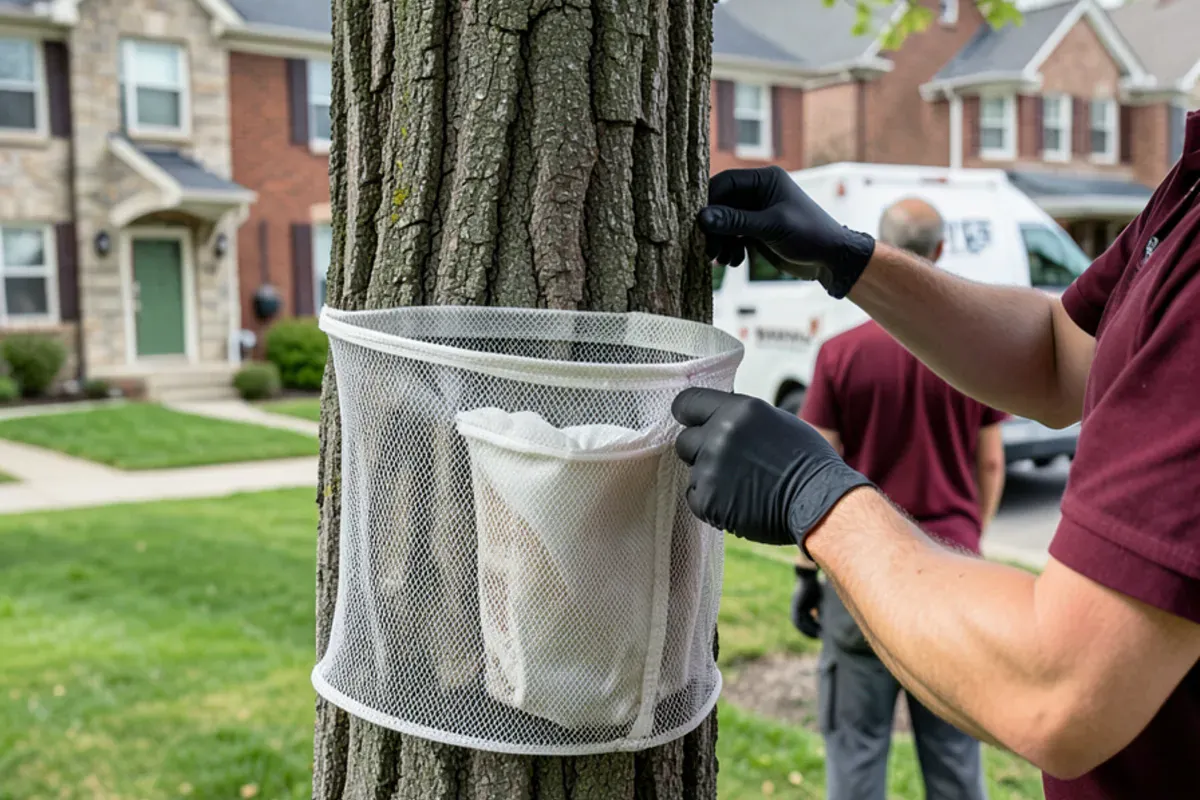
- Circle traps: funnel-style traps wrapped around the trunk catch nymphs as they climb. Unlike sticky bands, they do not trap birds or small mammals.
- Contact sprays: knock down nymphs and adults on lower limbs, walls and fences. Results are immediate but short-lived, and blooming plants are skipped.
- Systemic tree treatment: an insecticide applied to the bark or soil that the tree takes up, killing lanternflies as they feed. Longer lasting, but reserved for key host trees after bloom.
- Tree of heaven removal: cuts off the preferred food source. Cut trees resprout aggressively, so removal is usually paired with a stump treatment.
Your Lanternfly Visit, Step by Step
Book an inspection
Tell us where you are seeing egg masses, nymphs, adults or honeydew.
Tree and surface survey
We identify host trees, tree of heaven and egg masses, and note what is in bloom.
Written quote
You receive a quote that matches each method to the season and the tree.
Egg and trap work
Reachable egg masses are scraped and destroyed, and circle traps go on key trunks in spring.
Targeted treatment
Contact or systemic applications are made to selected host trees once bloom is over.
Follow-up
We check traps and trees later in the season and plan the next round of egg scraping for fall.
A Season-by-Season Lanternfly Calendar
From October through April, egg masses are the target, so scraping and destroying them is the most useful work. Nymphs hatch from roughly late April into June, which is the window for circle traps and early contact treatments.
By July, adults appear and gather on host trees through September and October, laying eggs until a hard freeze. Systemic treatments are timed for this summer feeding period on selected trees, and fall is the time to inspect everything stored outdoors before moving it.
What Affects the Cost of Lanternfly Treatment?
The written quote after inspection depends on:
Tree size is the biggest single factor. A pair of young red maples in a Brookhaven yard can be handled from the ground, while a mature black walnut or silver maple on a large Chadds Ford lot takes more product for a systemic treatment and has more egg masses out of reach.
Surroundings matter too. A property next to a rail embankment or an untreated lot full of tree of heaven keeps receiving adults all summer, so a multi-season plan is often more realistic there than a single visit.
- Number and size of host trees to treat
- Egg mass counts and how high they sit
- Traps, contact sprays, systemic work or a mix
- Tree of heaven on or next to the property
- One visit or a multi-season plan
- Pairing the visit with a mosquito yard treatment program or tick control along the wood line
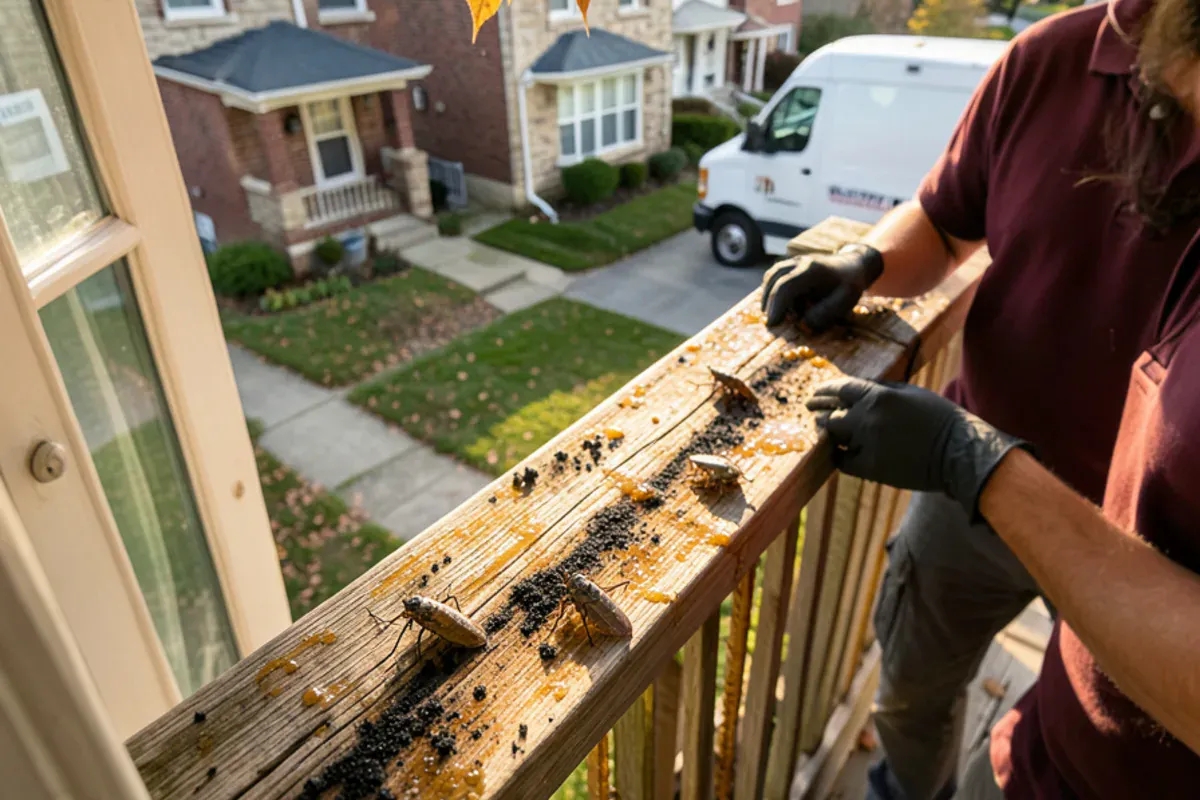
What our spotted lanternfly control includes
- Free inspection of host trees, fences and outdoor items
- Identification of tree of heaven on or near the property
- Egg mass scraping where masses are within reach
- Circle trap installation on key trunks in spring
- Targeted contact or systemic treatment timed after bloom
- Written quote matched to the lanternfly calendar
- Quarantine checklist for items moved off the property
Why call No Bugs Exterminator for spotted lanternfly control
Inside the zone
We are based in Media, in the middle of the quarantine area, so lanternfly season is something we plan around every year.
Free inspection, written quote
Thom and his team survey your trees for free and put the plan in writing before treating.
Open 7 days
We are open 7 days, 8 a.m. to 7 p.m., which helps when adults swarm a deck in late summer.
Same-day when possible
Same-day visits are often possible when the schedule allows — call early in the day if adults are coating the deck.
Rated 4.8 on Google
That rating comes from 21 Google reviews by local homeowners and businesses.
Where we provide spotted lanternfly control
Lanternfly pressure tracks tree of heaven and open industrial land, so we see heavy activity in the riverfront neighborhoods of Chester and Eddystone, along the Chester Creek valley in Aston Township and around the Routes 1 and 322 corridor in Concord Township. Each mixes host trees, rail or road edges and wooded yards where lanternflies spread easily.
- Marcus Hook
Industrial land around the Marcus Hook complex and the riverfront rail line gives tree of heaven room to spread up to nearby homes.
- Trainer
Riverfront ground beside the Monroe Energy refinery and the rail corridor along the Delaware leaves disturbed edges close to residential streets.
- Tinicum Township
Airport fence lines, I-95 shoulders and Essington's riverfront are the kind of disturbed edges where tree of heaven, the favorite host, takes hold.
- Ridley Township
With the Boeing plant, I-95 and the rail stop at Secane nearby, Holmes and Milmont Park yards sit close to corridors lanternflies travel along.
- Morton
This small borough sits right on the Media/Wawa rail line, and embankments along the tracks are typical tree of heaven ground.
- Middletown Township (Delaware County)
The Wawa rail station, Route 1 and wood lots around Elwyn and Glen Riddle mix travel corridors with the maples and walnuts lanternflies feed on.
- Upper Chichester Township
The Route 322 corridor through Boothwyn and Twin Oaks carries truck traffic that can move egg masses, with roadside edges where host trees grow.
- Montgomery County
King of Prussia's commercial core and the Schuylkill River towns combine heavy traffic, rail lines and riverbank trees inside the same quarantine.
- Springfield Township (Delaware County)
Baltimore Pike retail lots and I-476 edges sit near post-war Cape Cods whose maples and backyard grapevines draw adults in late summer.
What customers say on Google
4.8 out of 5 from 21 reviews on Google. Quoted as written by customers.
Very professional and knowledgable service providers. They mainly solved our problems in one visit!
Thom is a top-notch pest control specialist! And is one of the most genuine guys in the industry. He came to inspect a situation I had going on at the house, took his time, offered detailed advice, and didn’t take a penny.
Thom + his team were amazing. Very professional + provided me with a quote that made the most sense for my situation. Clearly I was not being gouged. Thom put the client first.
Spotted Lanternfly Control: common questions
Is southeastern Pennsylvania under the spotted lanternfly quarantine?
Yes. The Pennsylvania Department of Agriculture's quarantine covers the southeastern counties, including Delaware, Chester, Montgomery, Bucks and Philadelphia. Residents are asked to check vehicles, firewood and outdoor items for egg masses and insects before moving them, and businesses should review PDA's permit rules. This is general information, not legal advice.
When are lanternfly treatments most effective?
Each season has its own target. Egg scraping works from October to April, circle traps and contact sprays fit the nymph hatch from late April into June, and systemic tree treatments are timed for midsummer feeding, after the tree has finished blooming. Missing one window simply shifts the work to the next life stage.
Should I scrape egg masses myself?
Yes, for masses you can reach safely. Use a plastic card or putty knife to scrape them into a bag or jar of rubbing alcohol or hand sanitizer, then seal it. Check fences, stone walls, firewood and the underside of outdoor furniture. Masses high on trunks or limbs are better left to an inspection.
Do spotted lanternflies bite people or pets?
No. They feed on plant sap and do not bite or sting people or animals. The problems are the mess and the plant stress: sticky honeydew on decks and cars, black sooty mold, and the bees, wasps and yellow jackets that the honeydew attracts in late summer.
Will lanternflies kill my maple?
Usually not. Healthy maples, walnuts and willows typically survive lanternfly feeding, though years of heavy infestation weaken them and make them more vulnerable to drought and other stress. Grapevines and tree of heaven take the most damage. Reducing egg masses each winter is the simplest way to lower the load on a valued tree.
Related services
Helpful guides from our blog
Ready to get rid of the problem?
Thom and his team serve Media, Delaware County and southeastern Pennsylvania, open 7 days, 8 a.m. to 7 p.m..
- ★ 4.8 from 21 Google reviews
- Open 7 days, 8 a.m. to 7 p.m.
- Free inspection before treatment
- Family-run, based in Media, PA
Open 7 days, 8 a.m. to 7 p.m.