
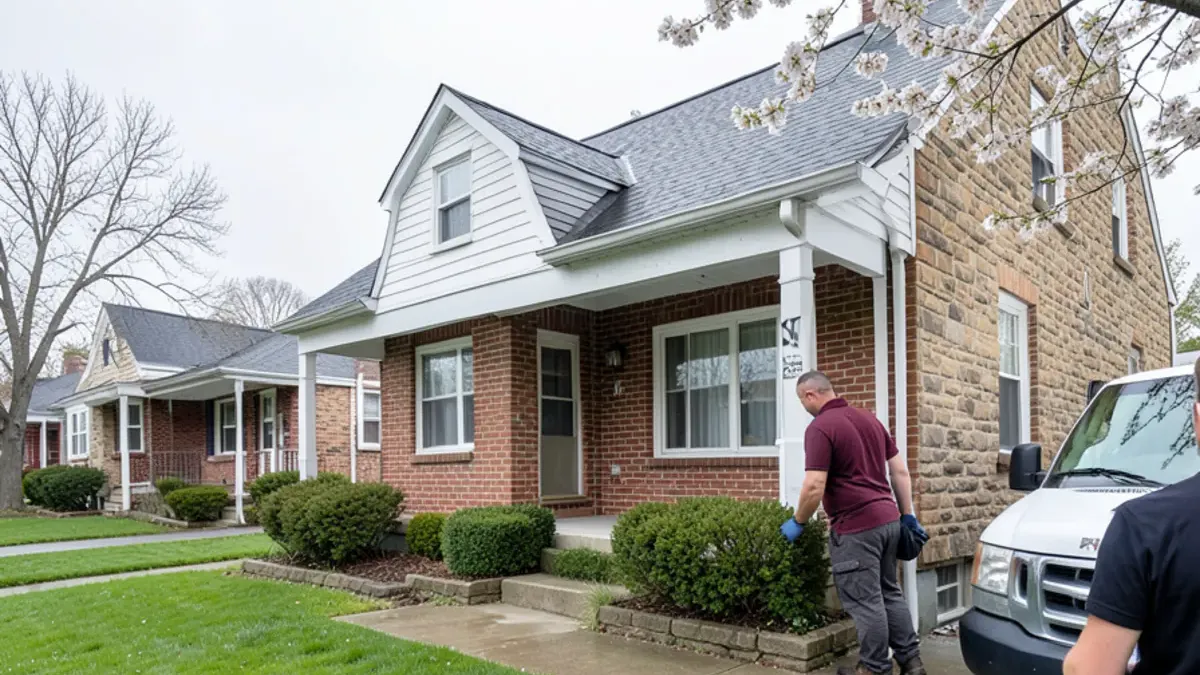
Termite season in PA is easiest to spot in spring, when warm days after a rain send clouds of winged termites out of the ground or out of your walls. Those swarmers are not the damage; they are the announcement that a mature colony is close by. What you do in the next few days decides whether that announcement turns into an inspection or a repair bill years from now.
When do termites swarm in Pennsylvania?
Eastern subterranean termites, the species behind nearly all termite damage in this region, usually swarm from about March through May. The trigger is a warm, still day, often right after rain, when soil moisture and temperature line up. Swarms typically happen in daylight and last less than an hour.
A swarm is how a colony reproduces. Winged males and females leave the nest, pair up, drop their wings and try to start new colonies in moist soil or wood. Most of them fail, but the colony they came from is still there, still feeding.
Termite swarm in spring: inside vs outside
Where you see the swarm matters. Swarmers outside, around a stump, a fence post or a woodpile in the yard, show that termites are active on your property. That is worth an inspection but not cause for alarm.
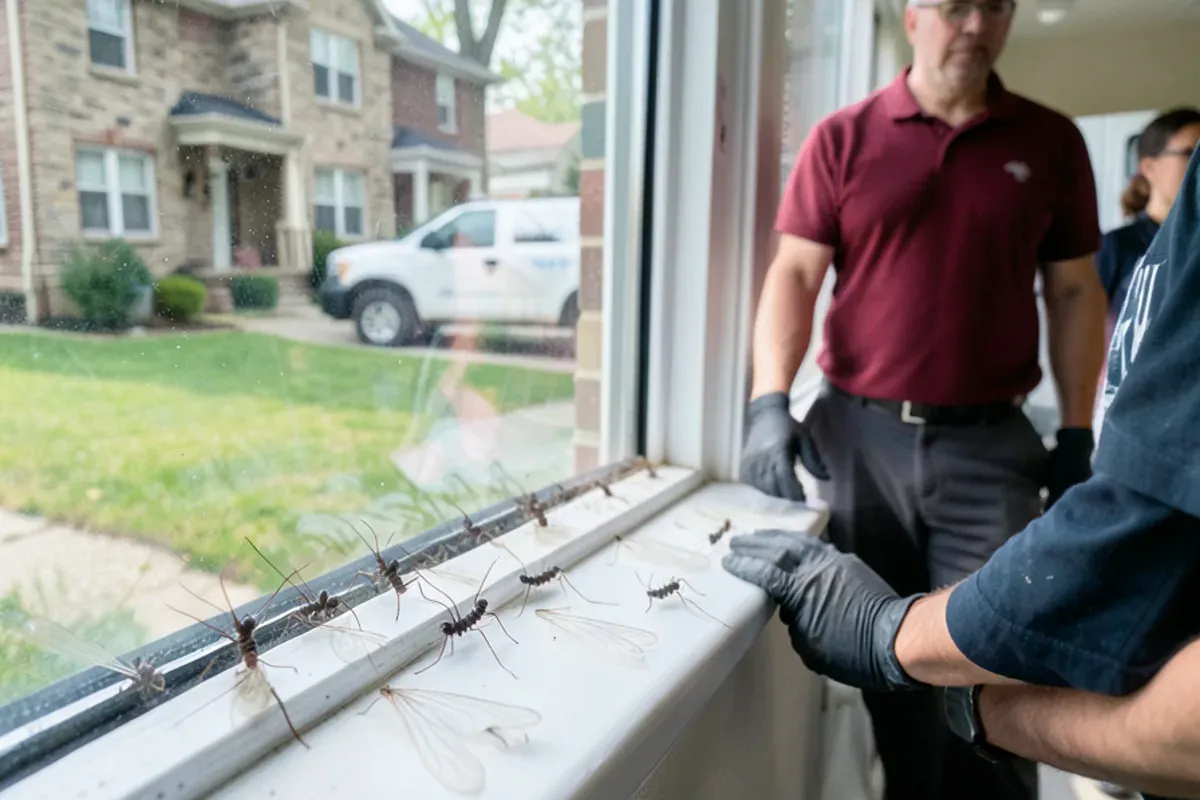
Swarmers inside the house are a different story. They almost always emerged from a colony feeding in or under the structure, often through a crack in a slab, around a basement window, near a bathtub drain or at a door frame. Indoor swarmers cannot survive long; they head toward light and die within hours. The colony that produced them remains.
How old is a colony that swarms?
Older than most people expect. An Eastern subterranean termite colony usually needs several years of steady growth before it produces winged swarmers at all, so a swarm in April means termites have been feeding nearby for a while. A mature colony can hold tens of thousands of workers or more, spread through a network of underground galleries.
Those workers forage well beyond the nest, often across a large part of a suburban lot, following roots, buried wood and moist soil. That is why the source of a swarm in the basement may sit under the slab porch, a buried form board or a dead tree by the driveway rather than directly under the spot where the swarmers came out.
Is it a termite or a flying ant?
Carpenter ants and other ants swarm in spring too, and the two get confused constantly. These features tell them apart:
| Feature | Termite swarmer | Winged ant |
|---|---|---|
| Waist | Thick, straight body with no pinch | Narrow, pinched waist |
| Antennae | Straight and beaded | Bent at an elbow |
| Wings | Two pairs of equal length, much longer than the body, shed easily | Front pair longer than hind pair |
| Color | Dark brown to black | Black, brown or reddish depending on species |
| What you find afterward | Piles of identical shed wings on sills and floors | Fewer shed wings, more whole insects |
What to do in the first day after a swarm
Do not panic or tear into walls
Termite damage builds over years. A few days to schedule an inspection will not change the outcome.
Save samples
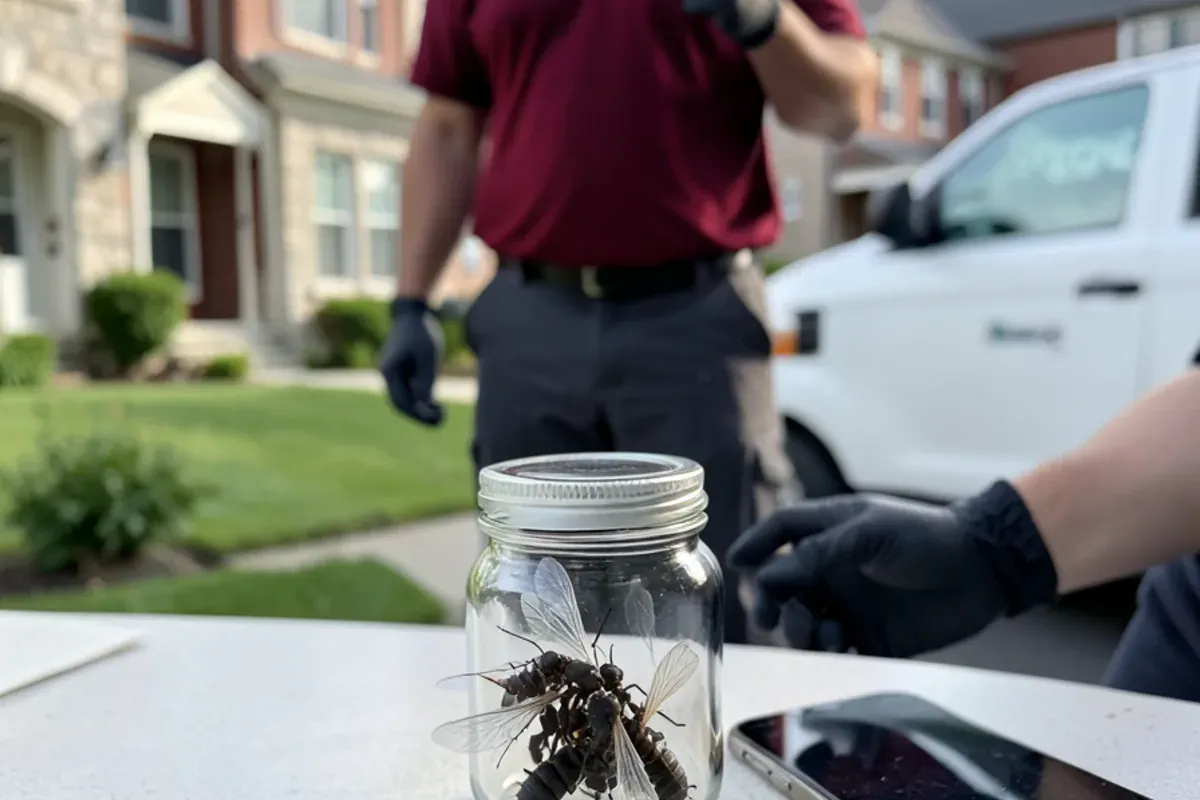
Collect several swarmers and some shed wings in a sealed bag or jar. A clear sample makes identification quick.
Take photos and note the location
Record exactly where they came from: a window, a crack in the floor, a baseboard, a door frame.
Vacuum the rest
Spraying swarmers does nothing to the colony and can make the source harder to find.
Schedule an inspection
Have the foundation, basement, crawl space and any wood near soil checked for mud tubes and damage.
Subterranean termites in Delaware County homes
Southeastern Pennsylvania lies in a moderate-to-heavy subterranean termite zone, and Delaware County's housing stock gives termites plenty of opportunities. Many neighborhoods were built after World War II, and Census (ACS) estimates put the median home build year in Springfield Township at 1955. Cape Cods and colonials from that era often have slab porches, attached garages, basement windows set low to the ground and wooden sills sitting close to soil.
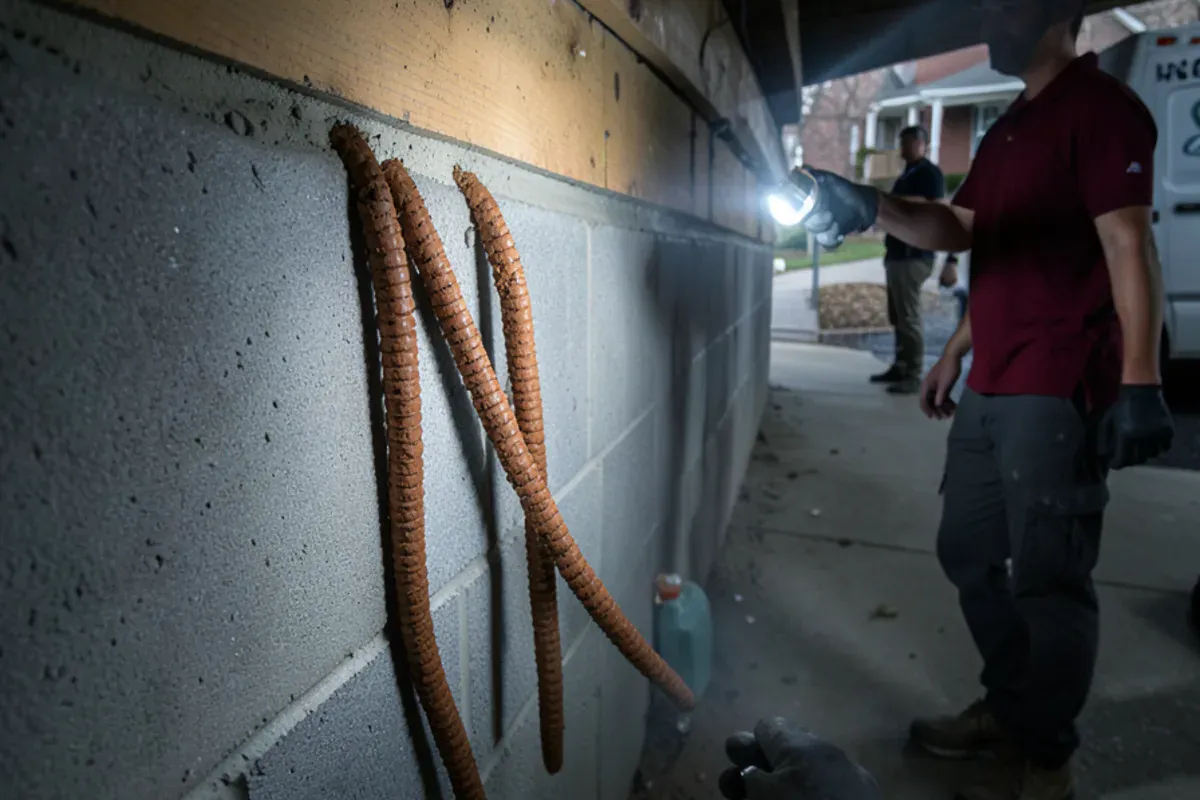
Termites build pencil-width mud tubes to travel from the soil to wood without drying out. Look for them on foundation walls, piers, sill plates and the backs of basement stairs. Mulch piled against siding, firewood stored against the house, leaky gutters and wood siding that touches the ground all make it easier for termites to reach the structure unseen.
A spring walk-around that makes the house less inviting
Swarm season is also a good weekend to take away the conditions termites use to reach wood unseen. Walk the outside of the foundation with a flashlight and work through this list:
- Rake mulch back a few inches from the foundation and keep the layer thin, so you can see the wall where it meets the soil.
- Make sure downspouts discharge several feet from the house and that soil slopes away from the foundation.
- Pull firewood, lumber scraps and old fence posts away from the walls and up off the ground.
- Look for wood siding, trim, door frames or deck posts touching soil, and note any spot with less than about six inches of clearance.
- Check the crawl space or basement for standing water, sweating pipes and damp sills, and run a dehumidifier where the air stays wet.
- Remove old stumps and buried wood near the house where you can; they feed colonies close to the structure.
Should you get a termite inspection in spring if you saw nothing?
It is a reasonable time to do it. Spring is when colonies are most active near the surface, so mud tubes and fresh damage are easier to find, and many homeowners schedule a termite inspection around swarm season for exactly that reason. Homes with a past treatment, a finished basement that hides walls, or a history of moisture problems benefit most.
If an inspection does find activity, treatment options include liquid soil treatments and in-ground bait stations, each with trade-offs that our termite control page explains. If the insects turn out to be ants, our carpenter ant control page covers the other common wood-damaging pest in this area.
Swarm calls from Springfield and nearby townships
When we follow up on a spring swarm, the source is usually close to where the swarmers appeared. We often trace indoor swarms to a hairline crack in a basement slab, the gap around a floor drain, or the joint where a slab porch meets the foundation. Finished basements make the search harder because paneling and drywall hide the walls termites prefer.
Springfield Township sits about 10 minutes from our Media base, and its post-war neighborhoods share many of the features described above. Every termite visit starts with a free inspection and a written quote.
A swarm does not always mean the house needs treatment, and we will say so when it does not. Swarmers rising from a rotting stump at the back of a Springfield lot call for monitoring and removing that wood; swarmers from a basement slab crack call for a full inspection of the structure. The harder cases are finished basements and slab additions, where paneling, carpet and drywall hide the foundation, and we note in writing which walls we could not see. If a past treatment is on record, ask the previous owner or provider for the paperwork, since it shapes what makes sense now. Treatment choices carry real trade-offs in drilling, disruption and monitoring, and we lay those out on the quote before anything starts.
Quick answers
Do termite swarmers eat wood or cause damage?
No. Swarmers do not feed on wood and die quickly if they cannot reach moist soil. The damage comes from worker termites in the colony, which stay hidden in soil, mud tubes and wood. That is why a swarm inside a Delaware County home is a signal to inspect the structure rather than a problem to spray.
Can termites swarm more than once a season?
Yes. A mature colony can release several swarms over a few weeks in spring, and nearby colonies may swarm on different days. Seeing swarmers again a week after the first event does not mean things are getting worse; it simply confirms that an active colony is close to the house.
Can I treat termites myself after seeing a swarm?
Store-bought sprays will kill the swarmers you can see, but they do not reach the colony underground. Effective subterranean termite treatment means placing product or bait stations in the soil along the full foundation, often by trenching or drilling slabs. Whoever does the work, ask for written re-treat terms and a diagram of what was treated.
The bottom line
A spring swarm is a warning with plenty of lead time, as long as you use it. Save a sample, note where they came from, and call (209) 563-1650 so Thom and his team can find the colony before it finds more of your house.
Sources

Written by the No Bugs Exterminator team
A small, family-run pest control business in Media, PA, led by owner Thom. We write about what we see on inspections in Delaware County and southeastern Pennsylvania. About us.
Services mentioned in this guide
Want a professional opinion?
Book a free inspection and get a written quote before any treatment.
- ★ 4.8 from 21 Google reviews
- Open 7 days, 8 a.m. to 7 p.m.
- Free inspection before treatment
- Family-run, based in Media, PA
Open 7 days, 8 a.m. to 7 p.m.