
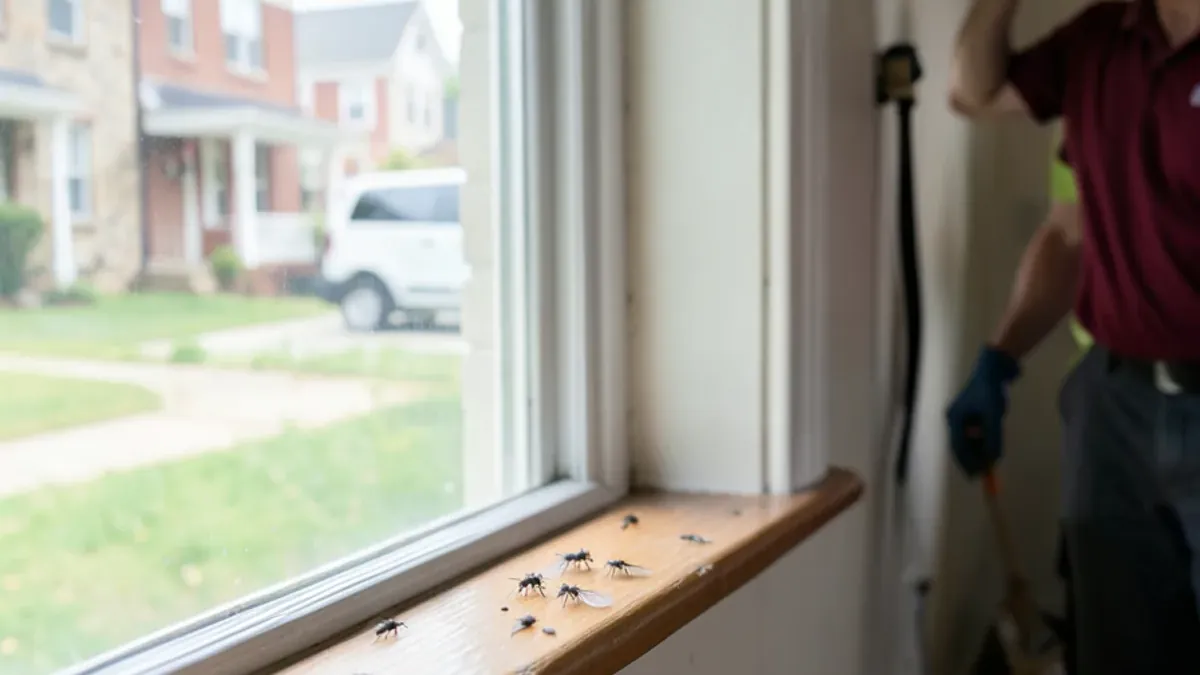
The fastest way to settle carpenter ants vs termites is to look at the waist: a carpenter ant is pinched in the middle like an hourglass, while a termite is thick from head to tail. Antennae and wings confirm it, and the wood damage each leaves behind is just as distinctive.
Termite or ant? Three features you can check with a phone camera
Getting the answer right matters, because the two insects need completely different treatments, and a close photo is usually enough to start.
Winged insects in spring send many homeowners into a panic, and both carpenter ants and Eastern subterranean termites produce winged swarmers around the same time of year. Catch one in a clear jar or press it onto clear tape, take a close photo, and compare three body parts.
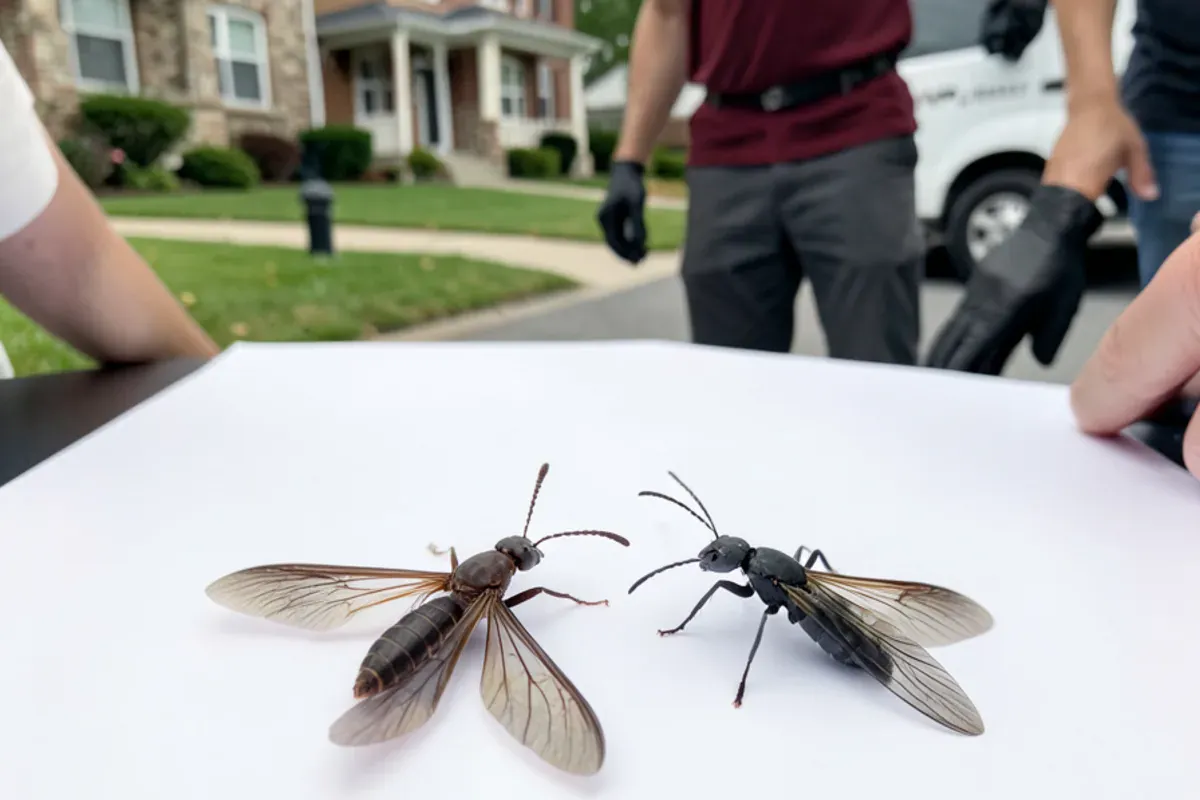
The waist is the clearest tell. Then look at the antennae: ants bend theirs at a sharp elbow, while termite antennae are straight and look like a string of tiny beads. Finally, count and compare the wings. Termites carry two pairs of equal length that extend well past the body; ants have front wings visibly longer than the hind pair.
Carpenter ants vs termites: a side-by-side chart for winged swarmers
Use this chart for the swarmers you find on windowsills, and for the workers you might spot in damaged wood.
| Feature | Carpenter ant | Eastern subterranean termite |
|---|---|---|
| Waist | Narrow and pinched | Broad, no visible pinch |
| Antennae | Elbowed, bent sharply | Straight and bead-like |
| Wings | Front pair longer than back pair | Two pairs, equal length, much longer than the body |
| Swarmer color | Black, or red and black | Dark brown to black |
| Size of swarmer | Larger, often half an inch or more | Smaller, about three-eighths of an inch including wings |
| Workers | Large black ants seen foraging, often at night | Pale, soft-bodied, rarely seen outside wood or mud |
| Damage | Smooth, clean galleries; wood is excavated, not eaten | Rough galleries packed with soil; wood is eaten |
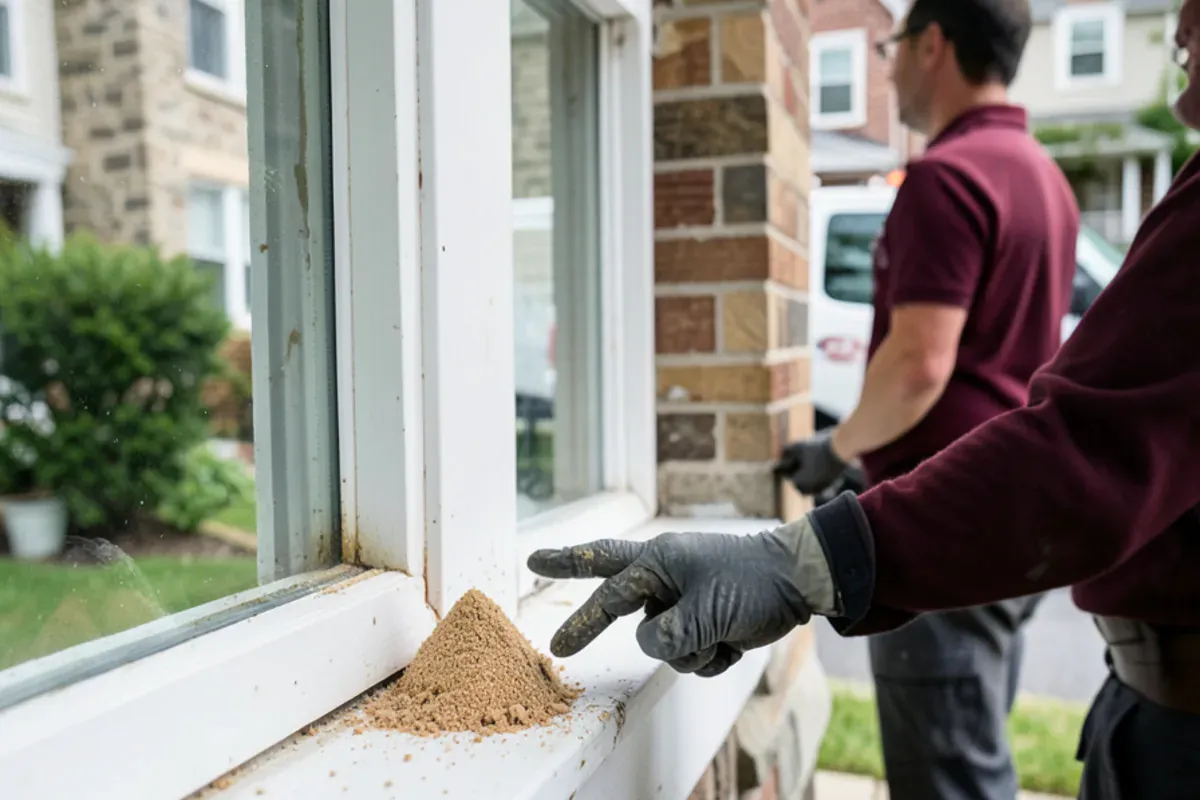
| Debris | Piles of coarse sawdust mixed with insect parts | Mud tubes and soil-lined tunnels, little sawdust |
Carpenter ant damage vs termite damage in the wood itself
Carpenter ants do not eat wood. They chew out nesting galleries and push the shavings out through small slits, so the giveaway is a cone of frass below a window frame, a porch post or a bathroom wall. Break open the wood and the tunnels look sanded smooth, almost polished.
Termites consume the wood, usually the softer layers between growth rings, and leave the harder grain standing in thin sheets. Their galleries are dirty, packed with a mix of soil and droppings, and they rarely break through the surface. From outside, termite-damaged wood can look sound until you press a screwdriver into it.
Moisture links both pests. Carpenter ants strongly prefer wood already softened by a leak, which is why we find them under failing window flashing and in deck ledgers. Subterranean termites need contact with soil moisture and build mud tubes to reach dry wood above the foundation.
When do termite swarmers and ants show up in Haverford Township?
Eastern subterranean termites usually fly on a warm spring day, often right after a soaking rain, and usually in late morning or early afternoon. A swarm inside a heated basement can happen earlier, sometimes in late winter. Carpenter ants tend to swarm a little later in spring and into early summer.
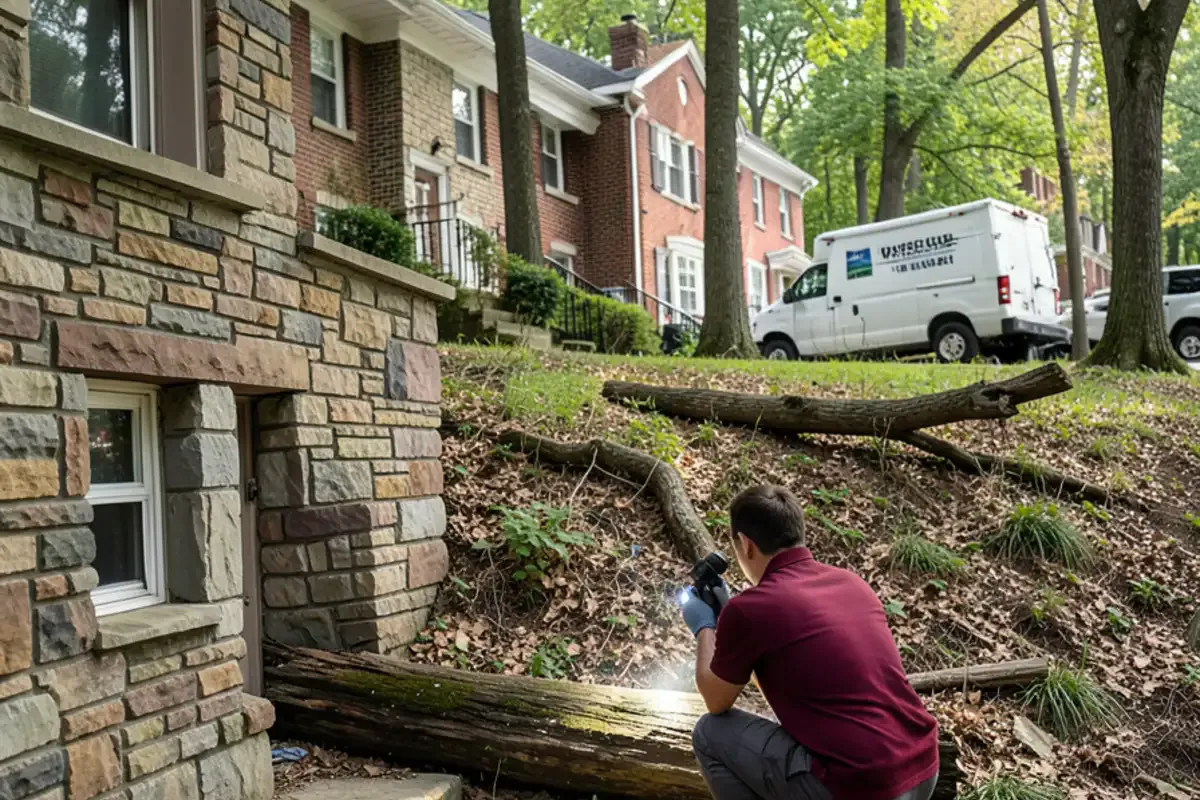
Timing is not proof by itself, but location helps. Half of Haverford Township's homes were built by about 1950, per Census (ACS) estimates, and many sit near the wooded banks of Darby Creek. Dead trees and stumps along those slopes make good carpenter ant nests, and the ants forage into nearby homes. Meanwhile, the township's mature foundations and porches give subterranean termites plenty of soil-to-wood contact. We work across Haverford Township on both problems every spring.
Found a winged insect indoors? What to do next
Save a sample
Collect two or three insects in a sealed bag or jar, or on clear tape. Shed wings on a sill are useful too, so leave them in place.
Note where and when
Write down the room, the time of day and whether it rained the day before. A swarm from a baseboard or slab crack is a stronger termite signal than one at a window.
Skip the spray
Killing swarmers does not affect the colony, and it can wash away the evidence that shows where they emerged.
Check the wood nearby
Look for frass piles, mud tubes along the foundation, or trim that sounds hollow when tapped.
Book an inspection
Bring the sample and your notes to the visit so the identification is fast and certain.
Why the identification changes the whole treatment plan
Carpenter ant work focuses on finding the parent nest and any satellite nests, treating them directly, and fixing the moisture that attracted the colony. Our carpenter ant control service usually pairs treatment with advice on trimming branches that touch the roof and drying out wet wood.
Termite work is a different discipline: a careful termite inspection of the foundation, sills and crawl spaces, then a soil treatment or baiting approach aimed at the colony underground. Our wider termite control page explains those options. Treating termites like ants, or the reverse, wastes a season while damage continues.
What spring swarm calls usually turn out to be
When we answer a spring call about flying ants, we start with the sample, because the insect the homeowner describes is not always the one we find. Shed wings piled on a basement windowsill near the sill plate point us toward termites; large black ants trailing across a kitchen at night point us toward a moisture problem in the walls or roof.
When the evidence is mixed, we check both. It is not unusual for an older home with a wet porch to have carpenter ants in the porch framing and a separate termite question at the foundation.
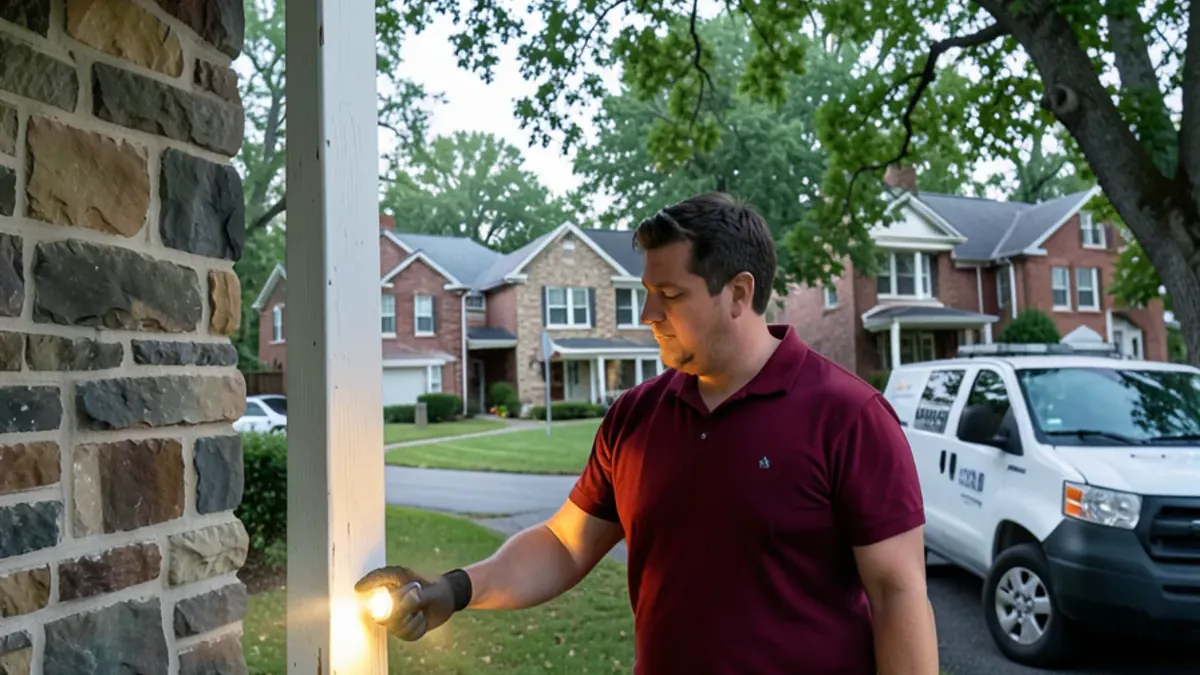
Carpenter ant workers forage mostly after dark, so we sometimes ask a homeowner to take a flashlight to the kitchen or the back porch around ten or eleven at night and note where the trail disappears into the wall. That spot is often the shortest route to the nest. The honest limit is that a nest buried inside a finished wall can take more than one visit to pin down, and we say so up front rather than treating every room at random.
Quick answers
Are flying ants or termites more dangerous to my house?
Termites, in most cases. They eat structural wood steadily and out of sight, while carpenter ants only hollow out nesting space and usually stay in wood already damaged by moisture. Both deserve attention. Carpenter ants in a wall are a sign of a leak, and a termite swarm indoors means an established colony is already feeding nearby.
Does finding a few wings on the windowsill mean termites?
Not by itself, but it is worth checking. Termite swarmers drop their wings soon after flying, leaving small piles of identical wings, all the same length. Ant wings come in two sizes. If the wings are near a basement window, a baseboard or a slab crack, save them for the inspection rather than vacuuming them up.
Can I treat carpenter ants myself?
You can slow foragers with baits, but the nest is usually inside a wall, door frame or roof void, and the colony often has satellite nests. Without finding and drying out the wet wood, the ants return. If you see frass piles or hear faint rustling in a wall at night, have the nest located before damage spreads.
The bottom line
A waist, a pair of antennae and a set of wings will usually tell you whether you are dealing with carpenter ants or termites. If the sample leaves any doubt, save it and call (209) 563-1650, and we will identify it and walk you through what comes next.
Sources

Written by the No Bugs Exterminator team
A small, family-run pest control business in Media, PA, led by owner Thom. We write about what we see on inspections in Delaware County and southeastern Pennsylvania. About us.
Services mentioned in this guide
Want a professional opinion?
Book a free inspection and get a written quote before any treatment.
- ★ 4.8 from 21 Google reviews
- Open 7 days, 8 a.m. to 7 p.m.
- Free inspection before treatment
- Family-run, based in Media, PA
Open 7 days, 8 a.m. to 7 p.m.